

Paper art is an artistic discipline that has taken galleries, advertising campaigns, publishing houses and shop windows by storm. What, just a few years ago, might have seemed like a craft technique reserved for creative niche markets has now become a constant source of inspiration for graphic designers, illustrators and art directors.
But what is it about paper that continues to fascinate us in the midst of the digital age? Why do compositions created using layers, cuts, folds and shadows evoke such a powerful emotional response? The answer goes far beyond aesthetics.
What exactly is Paper Art?
The term ‘Paper Art’ encompasses all those artistic expressions in which paper ceases to be merely a surface on which to work and instead becomes the primary material of the artwork.
Rather than using paper as a surface for drawing, printing or painting, the artist manipulates it by cutting, folding, layering, perforating, moulding or sculpting it to create two-dimensional, three-dimensional or semi-three-dimensional compositions.
Paper Art encompasses a wide range of disciplines:
- Papercut, or the art of paper cutting.
- Kirigami or the art of cutting and folding paper.
- Origami or the art of paper folding.
- Paper sculpture.
- Multi-layered illustration.
- Paper reliefs.
- Typography made from paper.
- Art installations.
The versatility of this technique makes it possible to create everything from small editorial pieces to huge immersive installations capable of completely transforming a space.
The interesting thing is that, even though the raw materials are extremely simple, the results can reach truly astonishing levels of sophistication.


A Brief History of Art on Paper
The origins of this art form are inextricably linked to the invention of paper in China during the 2nd century. Shortly after its emergence, decorative techniques based on cutting and folding began to develop. Many of these practices initially served ceremonial or religious purposes.
Over the centuries, these techniques spread across Asia and subsequently reached Europe, where paper began to be used to create silhouettes, ephemeral architectural decorations and intricate cut-out illustrations. During the 20th century, various artistic movements began to explore the sculptural potential of paper. However, it was in the last two decades that Paper Art experienced a veritable creative explosion.
The rise of social media played a key role. The layers, projected shadows and meticulous details create extremely photogenic images that work very well on visual platforms. Furthermore, the growing appreciation for craftsmanship and authenticity has helped the public to perceive these works as something special amidst the saturation of digital images.
Why is paper art so appealing to graphic designers?
The answer lies in its ability to bring together two seemingly opposing worlds. On the one hand, it retains the compositional precision characteristic of graphic design, with its visual hierarchy, rhythm, contrast, colour and narrative. On the other, it incorporates the imperfections and textures inherent in handcrafted work. The result is a combination that is as appealing as it is hard to ignore.
When we look at a piece of Paper Art, we immediately sense that there is a physical process behind it. We can picture the layers, the cuts, the assembly, the folds and the hours of work required to create the composition. That perception adds value.


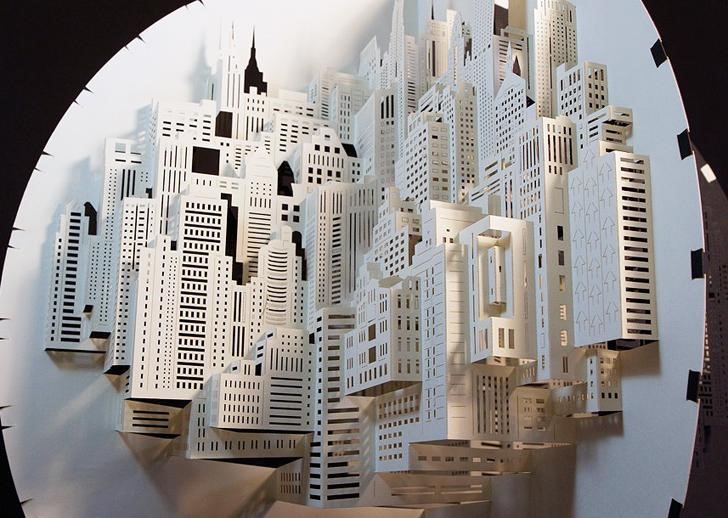
In a visual environment dominated by flat images, volume and depth can create a different experience that quickly captures the viewer’s attention.
The magic of layers
One of the most characteristic features of Paper Art is the use of overlapping layers. Each layer provides different visual information and helps to create depth.
Our brain automatically interprets these spatial differences as something more complex and interesting than a two-dimensional surface. Shadows play a fundamental role here.
Unlike digital shadows, which we often perceive as artificial effects, the real shadows produced by the paper convey a sense of authenticity that is difficult to replicate. It is precisely this interplay between light, volume and material that gives these works their great visual richness.
The Psychology of Paper Art
From a psychological perspective, the success of Paper Art makes perfect sense. We tend to value things that we perceive as the result of specialised manual skill. This phenomenon is linked to what is known as the “artisan effect”, whereby we attribute greater emotional value to objects that reflect human craftsmanship.
When we look at a piece made from paper, we usually experience several sensations simultaneously:
Proximity
Paper is a familiar material.
We have been using it since childhood to draw, write or do crafts. That familiarity creates an immediate emotional connection.
Warmth
Unlike industrial materials such as plastic or metal, paper conveys a sense of softness, fragility and humanity.
Awe
There is a fascinating contradiction in Paper Art: the material is simple, but the result can be extraordinarily complex.
Our brain enjoys discovering how something so ordinary can be transformed into a sophisticated work of art.
Nostalgia
Many of the pieces evoke childhood memories of cut-outs, pop-up books or school activities.
That emotional connection tends to elicit an almost automatic positive response.
A sense of authenticity
In an age characterised by automation and mass-produced content, handcrafted work conveys humanity, honesty and dedication. And that holds enormous communicative value for brands.
Paper Art and branding: a powerful combination
It is no coincidence that numerous advertising campaigns utilise the Paper Art aesthetic. Brands are constantly seeking to stand out and forge emotional connections with their audiences, and paper offers precisely that.
An illustration created using layers can convey:
- Creativity.
- Exclusivity.
- Sustainability.
- Relatability.
- Attention to detail.
- Artisanal innovation.
Furthermore, photographs of these pieces tend to make a strong visual impact in both print and digital media. This is why we are seeing more and more examples in packaging, shop windows, magazine covers, launch campaigns and social media content.


The perfect balance between analogue and digital
One of the reasons why Paper Art is experiencing such an exciting period is its ability to coexist with digital tools. Many current projects combine manual and technological processes.
Designers can develop the composition digitally, prepare vector files for laser cutting and then assemble the pieces by hand. It is also common to create physical sculptures that are subsequently photographed or animated digitally.
This blend allows us to make the most of the best of both worlds:
- Technological precision.
- Artisanal expressiveness.
- Scalability.
- Visual uniqueness.
Far from competing with technology, Paper Art demonstrates that manual techniques can be enriched by it.
What can we graphic designers learn?
Beyond the technique itself, Paper Art offers several valuable lessons for any creative professional, architect or artist.
- The first is that materiality still matters. We live surrounded by screens, but we continue to react emotionally to textures, volumes and physical objects.
- The second is that visual depth remains an extremely powerful narrative tool.
- Working with a seemingly simple material forces one to seek creative solutions, explore new forms of composition and develop a more conscious awareness of light, scale and space.
Conclusion
The quest for authenticity, an interest in artisanal processes and the saturation of digital images clearly work in favour of this artistic movement. It is true that the rise of digital manufacturing and advanced printing is vastly expanding the creative possibilities of the medium.
However, the most interesting thing about Paper Art is that its appeal lies in something much simpler: the ability to transform an everyday material into a surprising visual experience. And perhaps that is where the true magic of Paper Art lies. Because it reminds us that creativity does not always require complex materials or futuristic tools. Sometimes all it takes is a sheet of paper, a brilliant idea and a pair of hands ready to turn the ordinary into something extraordinary.

Hi, I’m Roberto Vidiella.
I am the founder and Creative Director of VIDI. I’m passionate about graphic design, and through this blog, I aim to deepen my knowledge and share what I’ve learnt throughout my career. If you leave me a comment, you’ll help me to keep learning and improving – and it really makes me happy!